

TABLE OF CONTENTS
Module 1: BORROWED CHORDS/MODAL BORROWING
a. Introduction and Modal Borrowing in Major Keys
b. Modal Borrowing in Minor KeysContent
c. Application in Four-Part Chorale WritingContent
d. Borrowed Chords and ModulationContent
e. Examples from the LIterature
f. Theory Skills Practice Exercises
g. Module Borrowing Assignment
Module 2: THE NEAPOLITAN 6TH CHORD
a. IDefinition, Origin, and Function
b. The Neapolitan Chord in Context: Baroque Period
c. The Neapolitan Chord in Context: Classical Period
d. The Neapolitan Chord in Context: Romantic Period
e. The Neapolitan Chord in Context: 20th Century, Jazz, Pop, World, Film
f. Four-Part Chorale Writing Guidelines
g. Theory Skills Practice Exercises
h. The Neapolitan Sixth Assignment
Module 3: AUGMENTED 6TH CHORDS BASICS
a.Introduction to Augmented Sixth Chords
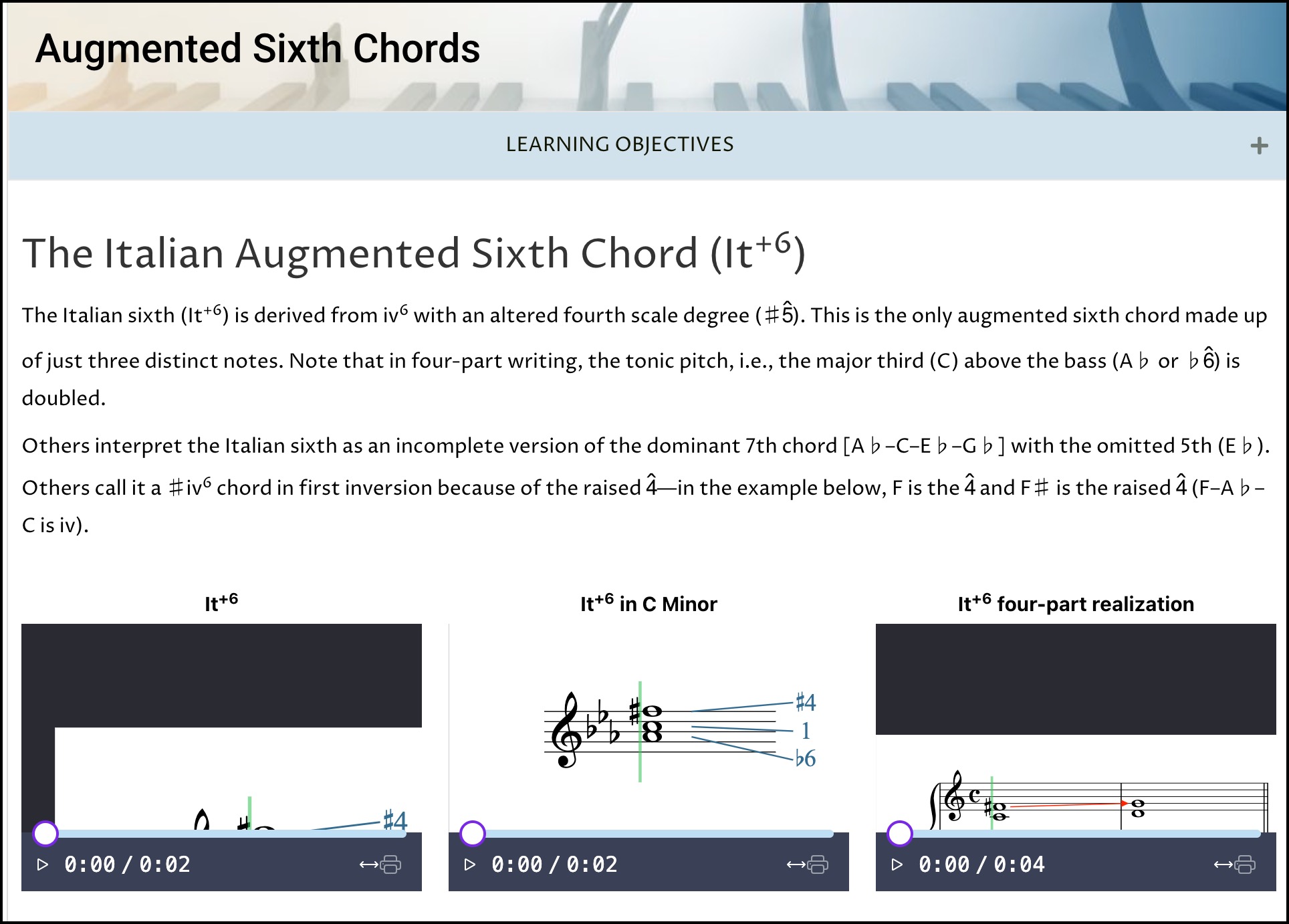
b. Italian Augmented Sixth Chord
c. French Augmented Sixth Chord
d. German Augmented Sixth Chord
e. Theory Skills Practice Exercises
f. Augmented Sixth Assignment 1
Module 4: AUGMENTED 6TH CHORDS: APPLICATIONS
a. Spelling Augmented 6ths in Different Keys
b. Augmented 6ths in Four-Part Chorale Writing
a. Augmented 6th Chords in Context: Baroque, Classical, and Romantic Periods
b. Augmented 6ths in Four-Part Chorale Writing
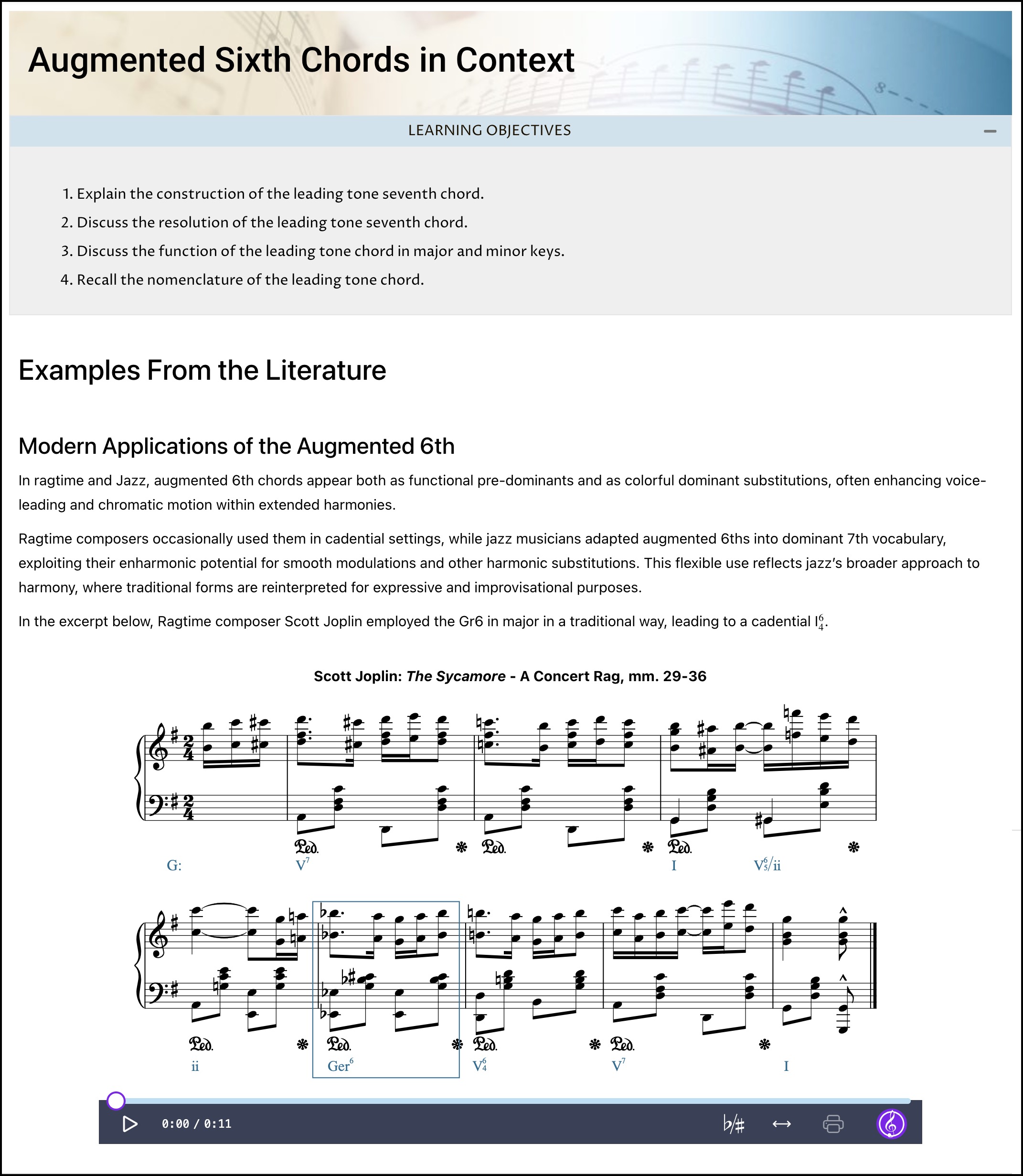
d. Augmented 6th Chords in Context: Modern Applications
e. Practical Exercises
f. Augmented Sixth Assignments
Module 5: VARIATION FORM: CONTINUOUS VARIATION
a. Continuous Variation: Introduction, Key Concepts, and Terminology
b. Continuous Variation Techniques in the Passacaglia
c. Historical Context
d. Analysis of Key Examples
Module 6: VARIATION FORM: THEME AND VARIATION
a. Introduction, Key Terminology, and Melodic Variation Techniques
b. Rhythmic Variation Techniques
c. Harmonic, Textural, and Timbral Variation Techniques
Module 7: SONATA ALLEGRO FORM: EXPOSITION
a. Introduction and The Exposition
b. Precursors to Sonata-Allegro Form
c. Sonata-Allegro Form in the Classical Period
d. Sonata-Allegro Form in the Romantic Period
e. Sonata-Allegro Form in the 20th Century and Beyond
f. Assignment Suggestions
g. Sonata-Allegro Exposition Assignment
Module 8: SONATA ALLEGRO FORM: DEVELOPMENT AND RECAPITULATION
a. Introduction and Key Concepts
b. Development and Recapitulation: Baroque, Classical, and Romantic Periods
c. Development and Recapitulation: 20th and 21st Centuries
d. Project Suggestions
e. Sonata Development and Recapitulation Assignment
Module 9: THREE-PART RONDO FORM
a. Introduction, Key Concepts, and Terminology
b. Historical Context: Baroque, Classical, and Romantic Periods
c. Historical Context: 20th and 21st Centuries
d. Assignment Suggestions
e. Three-Part Rondo Form Assignment
Module 10: EXTENDED RONDO FORMS
a. Introduction to Extended Rondo Forms
b. Five and Seven-Part Rondo Forms
c. Sonata-Rondo Form
d. Extended Rondo Forms: Baroque, Classical, and Romantic Periods
e. Extended Rondo Forms: 20th–21st Century Applications
f. Assignment Suggestions
Module 11: ALTERED DOMINANTS
a. Introduction to Altered Dominants and Vsub6 Chords
b. Altered Dominants in the Baroque, Classical, and Romantic Periods
c. Altered Dominants in Impressionism, 20th, and 21st Centuries
d. Application in Four-Part Chorale Writing
e. Altered Dominants Assignment
Module 12: COMMON TONE DIMINISHED CHORDS
a. Introduction, Key Concepts, and Terminology
b. Common Tone Diminished Chords in the Baroque, Classical, and Romantic Periods
c. Common Tone Diminished Chords in Ragtime, Jazz, and Early American Popular Music
d. Common Tone Diminished Chords in World Music, Rock, and Pop
e. Four-Part Writing ProceduresContent
f. Common Tone Diminished Chords Assignment
Module 13: 9TH, 11TH, AND 13TH CHORDS
a. Introduction, Key Concepts, and Terminology
b. Historical Context: Classical, Early and Late Romantic, and Impressionistic Periods
c. Ragtime, Jazz, Early 20th Century Popular Music, Film Music, and World Music
d. Four-Part Writing Procedures
e. Chord Extensions Practical Exercise
f. 9th, 11th, and 13th Chords Assignment
Module 14: CHROMATIC MEDIANTS: BASICS
a. Introduction, Key Concepts, and Terminology
b. How to Find and Build Chromatic Mediants
c. Voice-Leading Procedures in Four-Part Chorale Style
d. Historical Context, Classical Period to Film Music
e. Chromatic Mediants Assignment
Module 15: CHROMATIC MEDIANTS AND CHROMATIC THIRD RELATIONS
a. Historical Context, Classical Period to Rock and Pop, and World Music
b. Chromatic Mediants Assignment
Description
Integrated Resources
ISBN
OnMusic Theory III introduces all the necessary topics and practice opportunities that lay down a solid foundation of written and aural skills for first-year students.
A carefully designed but flexible learning sequence allows students to progress at their own pace through clear, approachable explanations, scores from multiple historical periods, and hundreds of relevant music, video, graphics, and interactive animations. Along the way, they can monitor their own progress through self-evaluation exercises.
Read Full Description
Academically rigorous, yet accessible and engaging, OnMusic Theory and Musicianship II is a complete music textbook, and gives you the most music for your online, hybrid, or face-to-face music course. Everything you need for your course is included. No downloads or extra resources necessary.
Music – Contains over 400 complete pieces – streaming right out of the pages. No other textbook (at any price) includes more music, and no other publisher has better implementation.
Highly Engaging and Interactive –Your students can actively interact with dictation and written skills practice knowledge checks. Additionally, students have access to multiple interactive practice exercises.
Online Music Dictionary – Only OnMusic titles offer integrated access to the Online Music Dictionary. This rich resource and C4E exclusive provides definitions, pronunciations, images, audio and much more.
Introduction Videos – Videos in every chapter reinforce student understanding and engagement. Our video applet keeps students on the page and on task.
Tests & Quizzes – Our online music appreciation textbook contains a comprehensive set of auto-graded quizzes and tests with test banks and anti-cheating measures built in. All testing is fully integrated and flows naturally from the text.
OnMusic Theory III
ISBN:979-8-9866023-4-9.